
Grandiose-TIER Hustle Asset
Roto-Rooter Tech
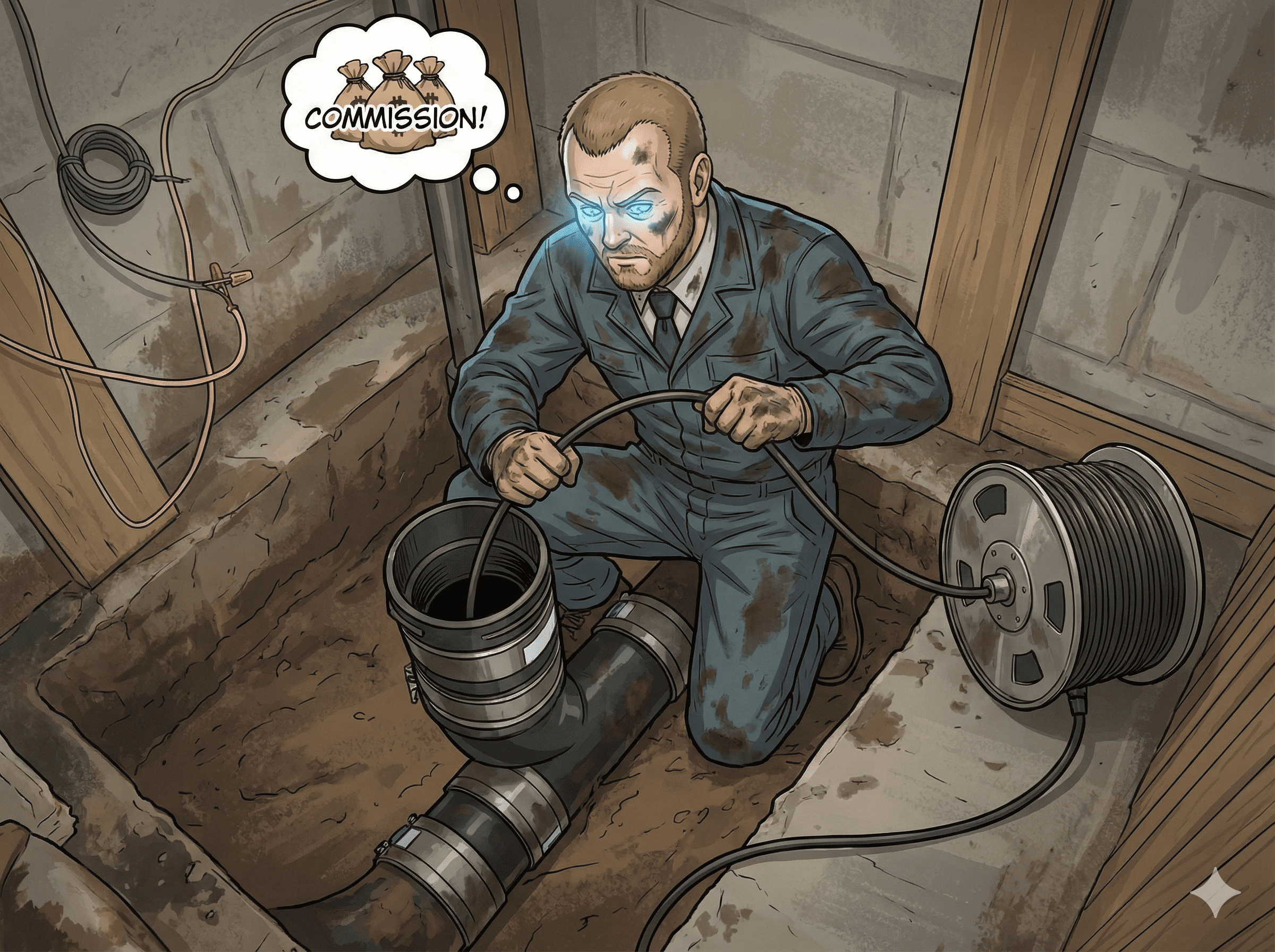
The Root Whisperer
Can look at a front yard tree and predict plumbing disasters with 99% accuracy. Upsells “Picote” cleaning for massive commission.
The Geo-Locator
Identifies the era of any Twin Cities home just by the smell of the basement drain. Navigation +100.
“I crawled through the sewers of Minneapolis so I could eventually sell you the house attached to them.”
The Sewer Rat: How I Learned Real Estate by Crawling Through Toilet Drains
The Origin Story of The Executive Jokester: Part 4
Asset Class: The Sewer Rat
Rarity: Essential Worker
Legacy: The Brown Gold
Introduction: The Pandemic Pivot
March 2020. The world stopped. Restaurants closed. Offices emptied. People baked bread and learned TikTok dances.
I decided to go play in the poop.
I had been bartending at Buffalo Wild Wings in Coon Rapids, hustling tips and slinging beers. But when the service industry collapsed overnight due to COVID-19, I needed a pivot. I needed something “Essential.” I needed a recession-proof job.
You know what never stops? Toilets.
People might stop eating out, they might stop traveling, but they will never stop flushing. So, I traded my apron for a hazmat suit and joined Roto-Rooter.
Into the Belly of the Beast
Most people see a house from the curb. They look at the paint color, the landscaping, the “curb appeal.”
I saw houses from the inside out—literally. I entered homes through the basement, trudged through the “unfinished” utility rooms, and stared directly into the abyss of the main sewer line.
Cleaning drains is not metaphorical work. It is visceral. It is smelly. It is hard, physical labor. You are hauling a 200lb cable machine (The Spartan) down narrow stairs. You are wrestling with a steel cable that is spinning at 400 RPM, trying to chew through tree roots that have invaded the pipe. You are covered in “sludge” that you pray is just mud (it’s not).
But I loved it.
Why? Commission.
Roto-Rooter wasn’t just a cleaning job; it was a sales job. I got paid for the work I did, but I got paid for the problems I solved. I was motivated by the hustle. If I could diagnose a broken line, explain the solution, and upsell the “Picote” high-speed cleaning, I made bank.
The “Blue Collar Scholar” of the Twin Cities
I didn’t realize it at the time, but I was getting a master’s class in Twin Cities Real Estate that no classroom could teach.
I entered thousands of homes across Minneapolis, St. Paul, and every suburb in between. And I started to notice patterns.
I became a Geo-Locator of Sewage.
I could tell you the era a home was built just by looking at the floor drain.
- 1920s Minneapolis: Clay pipes. Brittle. Tree root magnets. Nightmare fuel.
- 1950s Ramblers: Cast iron under the floor, Orangeburg (tar paper) to the street. Ticking time bombs.
- 1980s Suburbs: PVC. The holy grail. Smooth sailing.
I learned the geography of the metro area based on plumbing disasters. I knew which neighborhoods in South Minneapolis had the beautiful Craftsman homes with the disastrous sewer laterals. I knew which streets in Coon Rapids had “sags” in the line because the soil shifted.
I could walk into a basement, smell the air, and tell you, “This line has backed up three times in the last year, and they just painted the floor to hide the water stains.”
The Picote Upsell & The Root Whisperer
This is where the sales skills kicked in. Most technicians just wanted to poke a hole in the clog and leave. I wanted to fix it (and get paid).
I became an apprentice of the “Picote” machine—a high-speed chain knocker that essentially sandblasts the inside of the pipe, restoring it to its original diameter.
I would stand in a client’s front yard, point to the massive, beautiful Oak tree providing them shade, and say: “That tree is gorgeous. It’s also drinking your toilet water. Those roots are crushing your clay pipe. If we don’t mill this out now, you’re looking at a $15,000 excavation job next winter.”
It wasn’t a scare tactic; it was the truth. And it taught me how to explain complex, expensive structural issues to homeowners who just wanted their toilet to flush.
The “George Floyd Zone” & The Reality of the Job
Working through 2020 and 2021 meant I saw parts of the city that were effectively war zones. There were neighborhoods we weren’t allowed to enter without escorts. I saw the unrest, the boarded-up windows, and the tension.
But plumbing is the great equalizer. It doesn’t matter if you live in a mansion on Lake Minnetonka or a duplex in North Minneapolis—when the sewer backs up, everyone is desperate. Everyone is humble. Everyone just wants the “Sewer Rat” to save them.
I gained a respect for the infrastructure that holds civilization together. I floor-broke basements with jackhammers. I helped master plumbers relay lines. I saw the guts of the city.
Transitioning to Real Estate: The Secret Weapon
When I finally hung up the hazmat suit and put on the blazer to join The Minnesota Real Estate Team, I realized I had a secret weapon.
Other agents walk into a showing and say, “Look at this beautiful backsplash! Look at the crown molding!”
I walk into a showing and go straight to the basement. I find the cleanout cap.
“See how this cap is new? That means this line was opened recently. Why? See that water stain on the furnace leg? This basement floods.”
I look at the trees in the yard.
“That Silver Maple is 40 feet from the house. It’s a fast grower with aggressive roots. This house was built in 1964, so it’s likely cast iron transitioning to clay. We need a camera inspection immediately.”
My clients think I’m a wizard. I’m not. I’m just a former Roto-Rooter guy who knows that a pretty house with a broken pipe is just a very expensive Porta-Potty.
I crawled through the muck so my clients don’t have to. That’s the legacy of the Sewer Rat.
Get the “Sewer Rat” trading card and see the full stats at TheExecutiveJokester.com.