
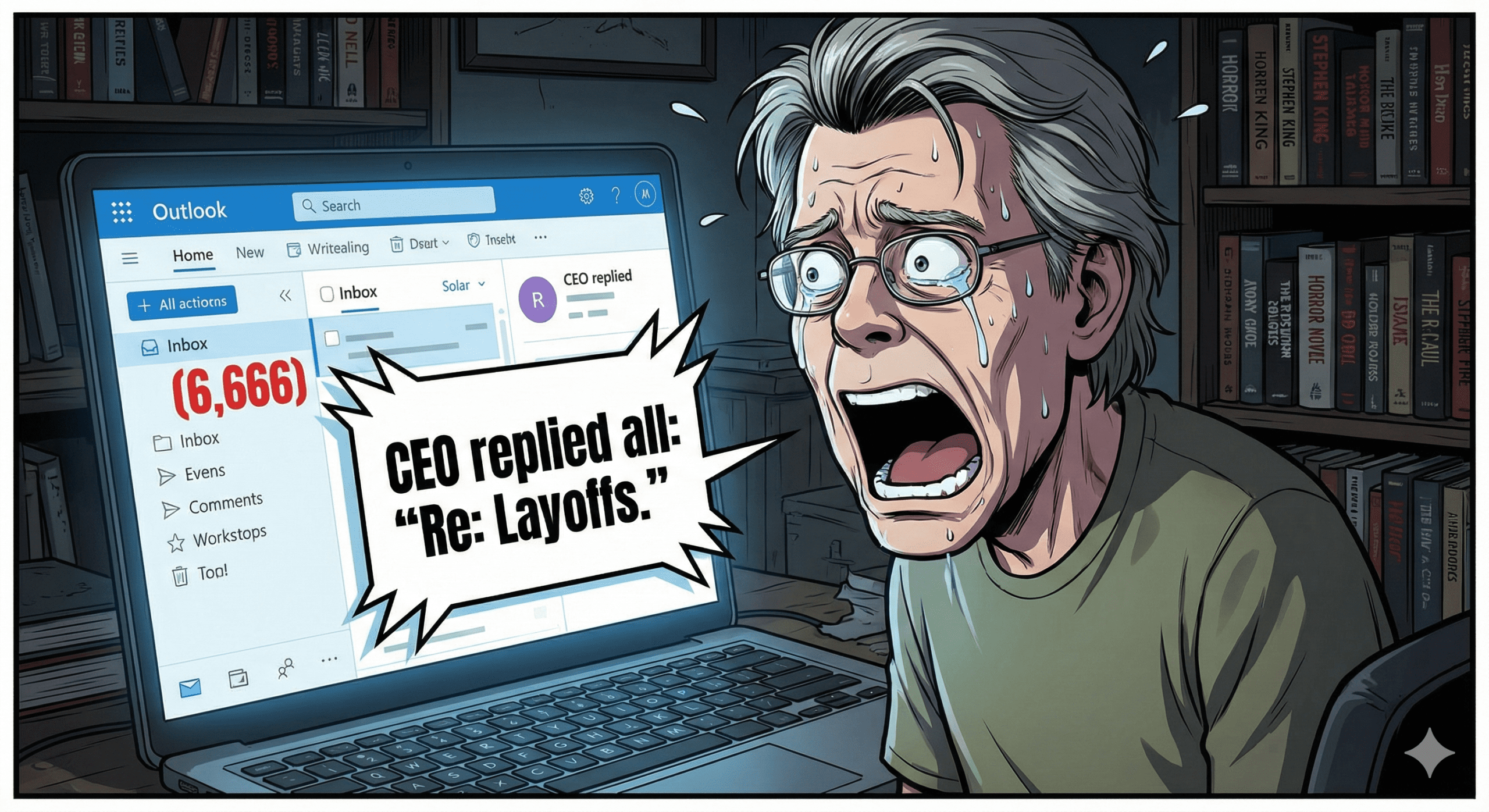
Subject Analysis: The “King Archetype” treats the quarterly review like a survival horror game. He believes every meeting could be an email, but prefers the meeting because it feeds on your fear.
Weakness: Bright Lights & Happy Hour.
His inbox has 6,666 unread messages. He leaves them there to intimidate the IT department.
The Executive Files
Swipe to identify your colleagues.
Misery Business:
Surviving the Horror Show
“All work and no play makes Jack a middle manager.” Why your office feels haunted (and it’s not just the flickering lights).
The fluorescent lights buzz with the sound of a thousand trapped flies. The coffee pot has been empty for hours, yet it continues to burn, filling the breakroom with the acrid scent of scorched ambition. You walk down the hallway, and for a moment, you swear you see two identical interns standing at the end of the corridor, chanting:
“Join us on the Zoom call… forever… and ever… and ever.”
Welcome to The King Effect.
Stephen King taught us that horror isn’t always about monsters under the bed. Sometimes, horror is mundane. It’s the isolation of a remote job in winter. It’s the rabid dog of a client who won’t stop barking. It’s the slow, creeping realization that you have been working on the same spreadsheet for 20 years, and you have become a ghost in your own life.
The modern office is a psychological thriller. And if you aren’t careful, you might just find yourself typing “All work and no play makes me a valuable asset” over and over again until HR intervenes.
01. The Monsters Among Us
Every King novel has a monster. In the office, they don’t wear clown makeup (usually), but they feed on your fear just the same.
Pennywise (The HR Rep)
“We all float down here… in the benefits package.”
They appear friendly. They offer you a red balloon (a company swag bag). But underneath the smile is a creature that feeds on policy violations. They know your deepest fears: Public speaking, performance reviews, and that one questionable expense report from 2019.
Cujo (The Office Printer)
“Good dog… nice dog… please don’t jam.”
It sits in the corner, dormant. But the moment you smell fear (or have a deadline), it attacks. It chews up your documents. It spits toner on your shirt. It cannot be reasoned with. It can only be put down.
The Langoliers (The Consultants)
“Eating up the budget and the past.”
They arrive from nowhere, eating up time and space. They consume the budget, leaving nothing behind but slide decks and empty promises. When they leave, the office feels emptier, quieter, and significantly poorer.
02. The Overlook Office
“You’ve always been the caretaker here.”
Have you ever looked at a coworker and thought, “I swear you’ve been sitting in that cubicle since 1921”?
The corporate environment is designed to distort time. A one-hour meeting can feel like a decade. A week can pass in a blur of emails. You start to lose track of the seasons. You look out the window and are surprised to see snow, because the last time you looked, it was July.
The Isolation of Remote Work (The Shining):
Working from home was supposed to be freedom. But for many, it became the Overlook Hotel. You are trapped with your family (or your cats) in a confined space. The internet goes out (the snowstorm). The walls start to close in. You find yourself talking to the bartender (your coffee maker) about the “management” (your toddlers).
Cabin fever is real. And in the corporate world, the only cure is a “Virtual Happy Hour,” which is arguably more terrifying than the ghosts in Room 237.
/// THE NIGHTMARE ///
The Bartender Narrative
“You look like you’ve seen a ghost,” the bartender says, wiping a glass with a rag that looks suspiciously stained.
“I saw the quarterly projections,” you whisper. “They were… red. All red.”
The bartender nods slowly. “Ah. The King Effect. You’re living in a horror story, but the monster isn’t a clown in a sewer. It’s the slow, creeping dread of irrelevance.”
He pours a dark liquid into a glass. It smokes slightly.
“Here’s the twist ending, friend. You aren’t the victim in this story. You’re the writer. You can write yourself out of the haunted house. You can kill off the character who stays late every night. You can close the book.”
“Or,” he grins, showing too many teeth, “you can wait for the sequel.”
03. Misery Loves Company
We cannot talk about Stephen King without talking about Misery.
Annie Wilkes is the ultimate micromanager. She claims to be your “Number One Fan.” She loves your work. She loves it so much she never wants you to leave. She hobbles your career so you can’t walk away.
Signs Your Boss is Annie Wilkes:
- They say things like, “We’re a family here” (Translation: You can never leave).
- They “edit” your work until it is unrecognizable, forcing you to rewrite it to their exact, insane specifications.
- They act betrayed when you take a sick day. “How could you do this to us? I thought we were a team!”
If you find yourself in this situation, do not wait for the sheriff. You have to save yourself. You have to find the typewriter, write your resignation letter, and smash it over their head (metaphorically, please. Use email).
The Executive Jokester’s Wisdom
How to survive the plot twists of your career.
The “Shining” (Intuition)
Trust your gut. If a meeting feels like a trap, it is. If a project feels doomed, it is. Use your “shine” to navigate the office politics before the elevator doors open and the blood pours out.
Character Development
In every horror movie, the character who survives is the one who adapts. The one who clings to the old ways (“But we’ve always done it this way!”) is the first to go. Be the Final Girl/Guy. Adapt. Survive.
“Get busy living, or get busy dying.” – The Shawshank Redemption (Also King, also applicable to your LinkedIn profile).